2030: mapping a World Cup
Stadiums, a construction site and high-speed rail: what the World Cup draws on Morocco
Six Moroccan stadiums out of twenty, a construction site billed as the world's largest stadium, a high-speed line extended to Marrakesh: the 2030 World Cup on the map, in three dimensions and in photos.
Loading the map…
1 / 11
GeoInsights
2030: mapping a World Cup
In 2030, for the first time, a World Cup will be played across several confederations at once — Africa and Europe, with three centenary matches in South America — and for the first time in North Africa. This story follows what the tournament draws on the map of Morocco: rebuilt stadiums, a 115,000-seat construction site, a high-speed line.
2 / 11
Rabat, 5 September 2025
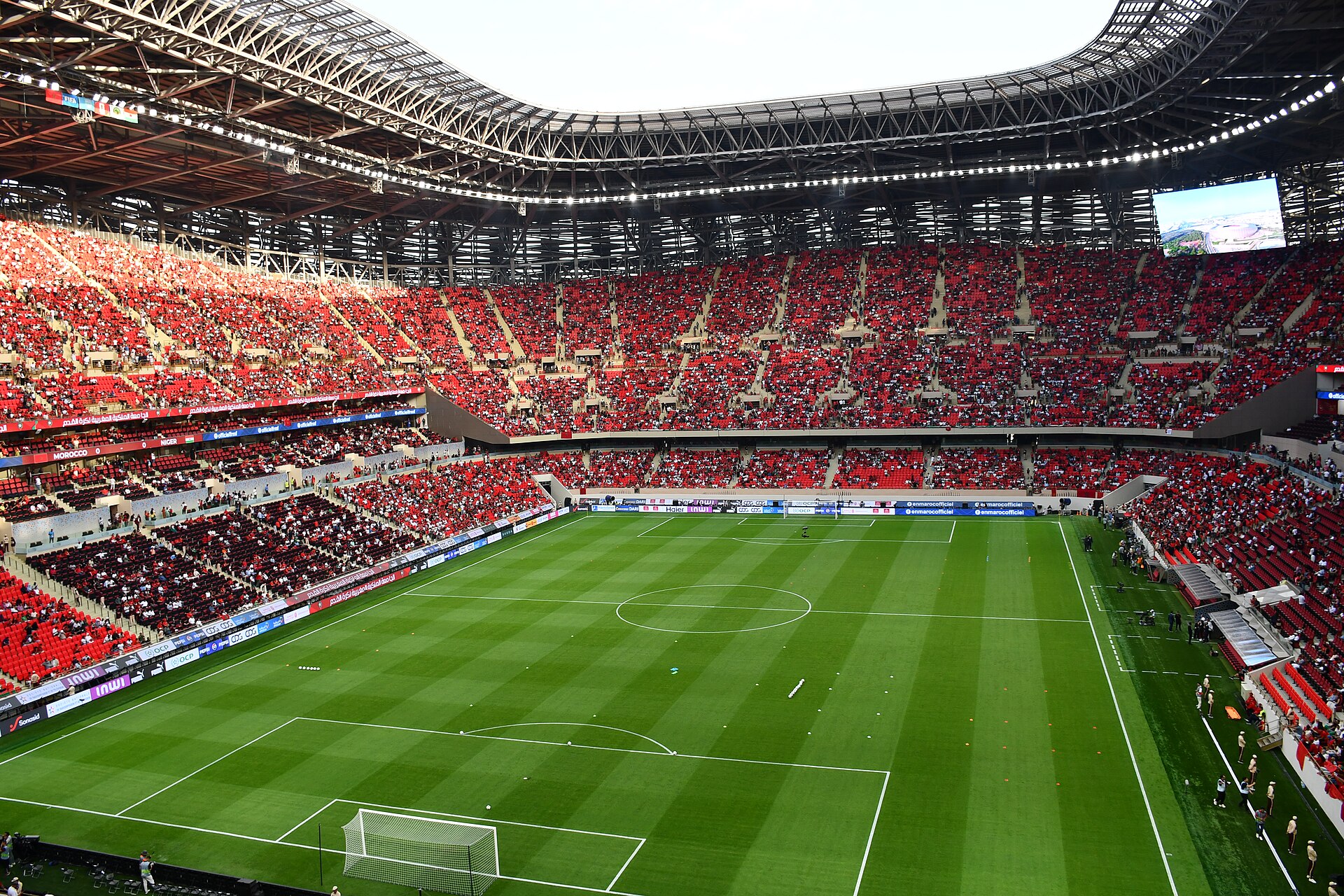
On its opening day, before the Morocco–Niger match: the new Prince Moulay Abdellah Stadium. It was rebuilt in two years, on the site of the former stadium of the same name, for the 2025 Africa Cup of Nations and then the 2030 World Cup.
3 / 11
Twenty stadiums, three countries
The bid list counts six stadiums in Morocco, eleven in Spain and three in Portugal. The circle shows the capacity planned for 2030: the largest is Moroccan, and does not exist yet. Valencia and Vigo were put forward in 2026, after Málaga and A Coruña withdrew.
March 14, 2023
Morocco joins the Iberian bid
After five lost bids (1994, 1998, 2006, 2010, 2026).
Source : Wikipédia, « 2030 FIFA World Cup »
December 11, 2024
FIFA confirms the three hosts
September 5, 2025
Prince Moulay Abdellah Stadium opens
Source : Wikipédia, « Prince Moulay Abdellah Stadium »
4 / 11
Six stadiums in Morocco
Five already exist: all hosted the 2025 Africa Cup of Nations, and are being enlarged or rebuilt for 2030. The sixth, in El Mansouria, east of Casablanca, is still a construction site. The photos sit on the stadiums; while exploring, a click enlarges them.
Source : Wikipédia, « 2030 FIFA World Cup » — liste des villes et stades candidats (capacités prévues pour 2030) (2030)
▸ See the data
| Hassan II Stadium | 115 000 |
|---|---|
| Tangier Grand Stadium | 75 500 |
| Prince Moulay Abdellah Stadium | 69 500 |
| Fez Stadium | 55 800 |
| Adrar Stadium | 46 000 |
| Marrakesh Stadium | 45 860 |
5 / 11
Rabat: 69,500 seats
The ring of stands and the pitch, as OpenStreetMap contributors drew them. The height is symbolic — one metre per 1,500 seats — not the roof's. The attendance record, 66,525 spectators, was set on 18 January 2026, for Morocco–Senegal.
0seats
capacity of the Prince Moulay Abdellah Stadium
Source : Wikipédia, « Prince Moulay Abdellah Stadium »
6 / 11
In the stands
Red seats under the steel frame that covers the stands, and a 105 × 68 metre hybrid pitch.
7 / 11
Tangier: enlarge rather than rebuild
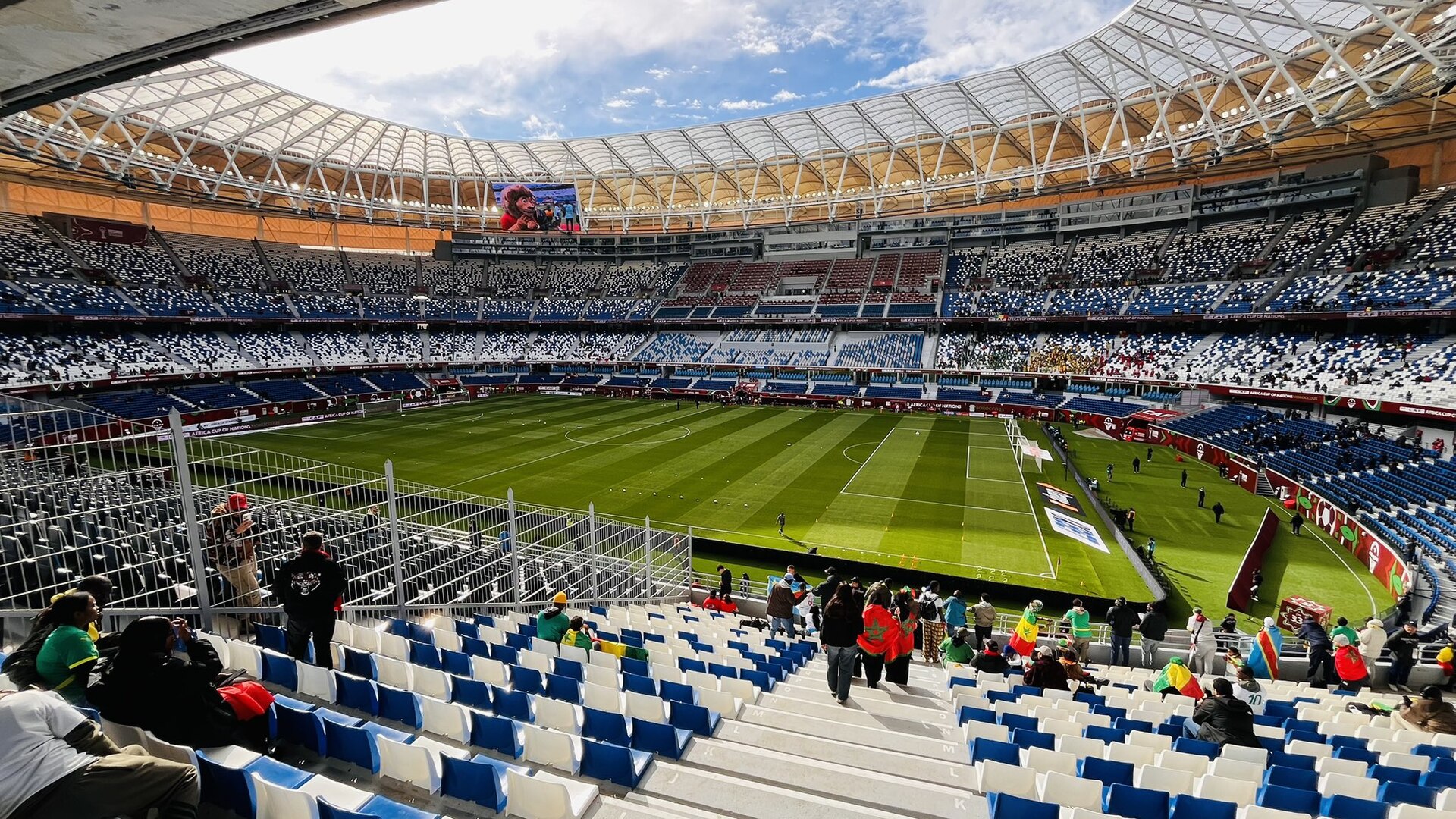
Opened in 2011, the Tangier Grand Stadium grew to 75,500 seats after works carried out from 2023 to 2025, costed at 360 million dollars: the largest of the tournament's Moroccan stadiums already in service.
8 / 11
El Mansouria: a 115,000-seat construction site
East of Casablanca, in Benslimane province, the future Hassan II Stadium is still only a construction footprint. Announced in October 2023, with 115,000 seats it would be the largest football stadium in the world. It is to host Raja, Wydad and the national team.
0seats
announced capacity of the Hassan II Stadium
Source : Wikipédia, « Hassan II Stadium »
9 / 11
From one stadium to the next by train
Since 15 November 2018, Al Boraq has linked Tangier and Casablanca in 2 h 10 instead of 4 h 45, running at up to 320 km/h on the 186 km of new line to Kenitra. The extension to Marrakesh, dashed, is under construction in three sections: Kenitra–Aïn Sebaâ, Aïn Sebaâ–Nouaceur, Nouaceur–Marrakesh.
Source : Wikipédia, « Al Boraq » — passagers transportés (chiffres de l'ONCF) (2019–2024)
▸ See the data
| 2019 | 3 |
|---|---|
| 2020 | 1,3 |
| 2021 | 2,4 |
| 2022 | 4,2 |
| 2023 | 5 |
| 2024 | 5,5 |
10 / 11
Your turn
Free the map: click a photo to enlarge it, zoom in on a stadium to see its stands in relief, follow the high-speed line.
11 / 11
Sources and method
Everything this story states comes from here: the data tables, the references cited and the catalogue datasets, with their licence and date.
Data
Licence : ODbL 1.0Updated : 2026-10-06
Tribunes (relations « building=stadium »), pelouses et chantier du stade Hassan II, extraits d'OpenStreetMap le 6 octobre 2026. Hauteurs figurées : 1 m pour 1 500 places de la capacité prévue pour 2030 (Wikipédia, « 2030 FIFA World Cup »), pas la hauteur réelle — OSM n'en donne aucune.
Licence : ODbL 1.0Updated : 2026-10-06
Voies « highspeed=yes » en service et en construction, extraites d'OpenStreetMap le 6 octobre 2026, fusionnées et simplifiées (≈ 40 m). Le tronçon en construction est celui que les contributeurs ont déjà relevé.
Period : 2030Licence : CC BY-SA 4.0Updated : 2026-10-06
Capacities announced for the tournament, after renovation or construction. Positions: OpenStreetMap (Nominatim for Spain and Portugal).
Wikipédia, « Al Boraq » — passagers transportés (chiffres de l'ONCF)
Period : 2019–2024Licence : CC BY-SA 4.0Updated : 2026-10-06
References
- Wikipédia, « 2030 FIFA World Cup » · 2026-10-06 · CC BY-SA 4.0
- Wikipédia, « Prince Moulay Abdellah Stadium » · 2026-10-06 · CC BY-SA 4.0
- Wikipédia, « Tangier Grand Stadium » · 2026-10-06 · CC BY-SA 4.0
- Wikipédia, « Hassan II Stadium » · 2026-10-06 · CC BY-SA 4.0
- Wikipédia, « Al Boraq » · 2026-10-06 · CC BY-SA 4.0
Layers prepared for this story
Not in the catalogue: these data were prepared for the story and are not downloadable. The original source is authoritative.
Stades marocains de la Coupe du monde 2030 — tribunes, pelouses, chantier
OpenStreetMap (contributeurs) · Licence : ODbL 1.0
Tribunes (relations « building=stadium »), pelouses et chantier du stade Hassan II, extraits d'OpenStreetMap le 6 octobre 2026. Hauteurs figurées : 1 m pour 1 500 places de la capacité prévue pour 2030 (Wikipédia, « 2030 FIFA World Cup »), pas la hauteur réelle — OSM n'en donne aucune.
Ligne à grande vitesse Tanger – Kénitra et prolongement vers Marrakech
OpenStreetMap (contributeurs) · Licence : ODbL 1.0
Voies « highspeed=yes » en service et en construction, extraites d'OpenStreetMap le 6 octobre 2026, fusionnées et simplifiées (≈ 40 m). Le tronçon en construction est celui que les contributeurs ont déjà relevé.
Photo credits
- Rabat, 5 September 2025 — Reda benkhadra, CC BY-SA 4.0 — Wikimedia Commons
- In the stands — Reda benkhadra, CC BY-SA 4.0 — Wikimedia Commons
- During the Africa Cup of Nations, December 2025 — Ymax2016, CC0 — Wikimedia Commons
Methodology
Capacities: list of candidate stadiums in the Wikipedia article “2030 FIFA World Cup” (projections for 2030). Stands, pitches, the Hassan II Stadium site and high-speed tracks: OpenStreetMap, extracted on 6 October 2026 and stored in two story layers; the section under construction is what contributors have mapped, and some stretches may be missing. Stand heights are symbolic (1 m per 1,500 seats): OpenStreetMap gives no real height. Photos: Wikimedia Commons, freely licensed, credited. The moving trains show the direction of travel, not a timetable.
Boundaries: Natural Earth 1:50m (public domain), Morocco as a single polygon. Satellite basemap: Esri World Imagery.